What Does 1 mL of Dermal Filler Look Like? The Visual Teaspoon Guide
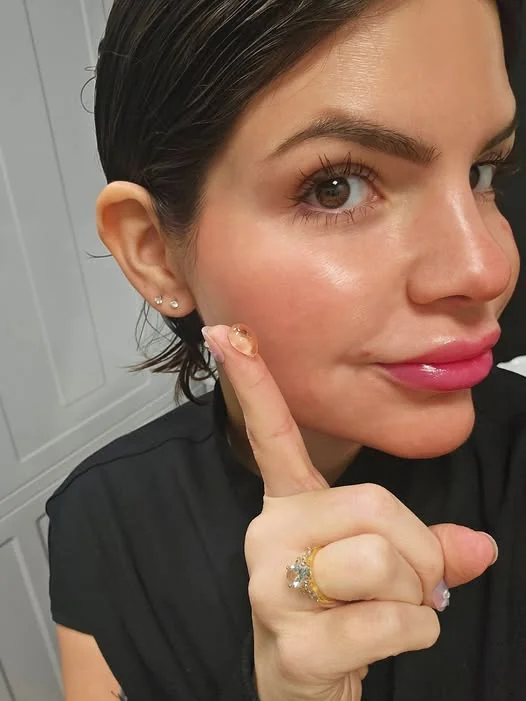
A clinical nurse injector demonstrates a 1 mL drop of hyaluronic acid dermal filler on her fingertip, showing how compact a single syringe actually is.
Executive Summary
'Filler phobia' is driven by the misconception that a single syringe will distort facial proportions. In clinical reality, a standard 1.0 mL syringe contains only one-fifth (20%) of a single 5.0 mL measuring teaspoon.
Key Clinical Realities:
- ✓The Teaspoon Standard: It takes five full 1.0 mL syringes of filler to fill a single standard kitchen measuring teaspoon.
- ✓Anatomical Diffusion: When placed across cheekbones or nasolabial folds, 1 mL is deposited as fractional droplets beneath deep tissue planes.
- ✓Overfilling Etiology: Unnatural 'pillow face' results from multi-syringe stacking over years or incorrect superficial placement, not from a single conservative syringe.
Demystifying 'Filler Phobia'
The single greatest psychological barrier preventing patients from seeking aesthetic volume restoration is the fear of looking artificial, distorted, or 'overfilled.' Pop culture and social media frequently showcase exaggerated facial contours, leading consumers to believe that a single syringe of filler will drastically alter their facial identity.
In clinical reality, a single syringe contains a remarkably minute quantity of substance: exactly 1.0 milliliter (1.0 cc).
The Teaspoon Metric: 1/5th of a Teaspoon
To understand the true scale of facial filler, consider a standard measuring teaspoon found in your kitchen drawer. That single teaspoon holds 5.0 milliliters of liquid. An entire syringe of Juvederm, Restylane, or Versa is only 1.0 milliliter—precisely 20% of that single spoon.
When an injector places a full syringe across both cheeks, they are depositing roughly one-tenth of a teaspoon on the left cheekbone and one-tenth on the right cheekbone. Spread across anatomical muscle planes and deep supraperiosteal fat compartments, this volume creates subtle light reflection and structural support rather than bulging distortion.
Why Do Some People Look Overfilled?
If 1 mL is so small, why do some celebrities and patients end up with prominent 'duck lips' or 'pillow cheeks'? Clinical distortion occurs due to three specific errors:
- Cumulative Over-Injection: Patients receiving 2 to 4 syringes annually without allowing previous filler to naturally metabolize, leading to product stacking.
- Incorrect Depth of Placement: Placing high G-prime structural fillers into delicate superficial dermal layers instead of deep on the bone.
- Migrated Product: Injecting beyond anatomical boundaries or using improper pressure, causing product to migrate into the cutaneous lip or lower eyelid hollows.
Related Aesthetic Guides
Patient Safety & Provider Standards
Frequently Asked Questions
How many teaspoons is 1 mL of filler?
One milliliter (1 mL) is exactly 0.2 teaspoons—meaning it takes five full syringes of filler to fill a single standard 5 mL kitchen teaspoon.
Can 1 syringe of filler make you look overdone?
In the hands of a qualified injector, 1 mL cannot make a face look overdone. The 'pillow face' or 'overfilled' look is caused by 6 to 10+ syringes placed repeatedly over time or misplaced into superficial fat pads.
Where does 1 mL of filler go during a treatment?
One mL can be placed entirely in the lips for moderate volume, or split between both cheeks (0.5 mL per side), or split between nasolabial folds to soften smile lines.
Why do lips look huge immediately after 1 syringe?
Immediate post-treatment fullness is caused by localized trauma, needle passes, and acute inflammatory edema (swelling), not the filler itself. Swelling peaks at 24 to 48 hours and subsides over 7 to 14 days.
Editorial and Clinical Review: Content on Medical Spa Providers is for informational, educational, and consumer-vetting purposes only and does not constitute formal medical advice. All aesthetic procedures carry risks of swelling, bruising, vascular complications, or asymmetry. Always schedule an in-person consultation with a licensed prescribing healthcare provider before undergoing clinical aesthetic treatments.
For med spa owners
Own a med spa? Get on the register.
People compare providers here by rating and services. Make sure your listing is present, current, and correct — it's free.